

IN CONVERSATION WITH AUDREY HOPE RINEHART
Audrey Hope Rinehart is a photographer whose work is rooted in freedom, fearlessness, and the transformative power of self-expression. Having spent many years on the other side of the camera as an arts and glamour model, she brings a rare depth of understanding to every image she creates. Her photography is unapologetically bold—a visual celebration of individuality, identity, and the courage to be fully seen. Through vivid colors, striking textures, and meaningful collaborations, Audrey creates far more than beautiful photographs: she creates spaces where people can reclaim their stories, embrace their authentic selves, and exist without shame.
1. How did your journey into photography begin?
My journey into photography actually began on the other side of the camera. For most of my twenties and thirties, I worked as an arts and glamour model, traveling around the United States and posing for lighting workshops, instructional events, and group shoots focused on figurative photography.
Each trip or tour was different. Sometimes I did studio work all day; other times, I was suspended from railroad bridges for Shibari artists or hiking into desert locations to pose for groups of photographers. I also participated in many urban exploration shoots inside abandoned buildings, which required a certain level of daredevilry, since entering those locations was not always exactly legal.
In 2008, I flew to Los Angeles to work with a figure photographer who was well known within the community at the time, though he has since passed away. During that trip, I met other West Coast models and had the opportunity to work in Joshua Tree National Park. A year or so later, I was posing for group shoots in the extraordinary deserts outside Salt Lake City and Las Vegas.
I knew my path in life would be somewhat outside the norm when it came to work and career. I also knew that my happiness and long-term well-being would depend on pursuing creative goals rather than following the avenues traditionally expected of me.
Those years were amazing. My modeling work can still be found in books and has been displayed in galleries and exhibitions around the world. However, the modeling industry was far less inclusive at that time than it is today. I am very short—only five feet tall—and I was already considered “old” by the time I started. As a result, I was quickly pigeonholed into a particular niche.
Even as a veteran creative capable of portraying many different roles, I struggled to move beyond the ultra-feminine, “forest nymph” type of work. Back then, when a model was paid for a shoot, she often never even got to see the work she had helped create. It was considered a courtesy for a photographer to share even one finished image with a paid model.
I worked with hundreds of photographers and artists over the years, yet I only ever saw a small portion of the work we produced together. That is one of the main reasons I now try to deliver images to the people I photograph very quickly—often within 24 hours. I believe people deserve to have some sense of power over their own likeness and how it is portrayed.
Over time, the niche I felt forced into became oppressive. Even after all those years, I never felt I had been able to express the full range of my creative vision. I certainly could not do that while allowing other people—generally much older male photographers—to define what they saw in me.
At a certain point, I knew more about lighting than many of the people I was working for, but I had to remain quiet and simply do my job. Figure and art models also typically use aliases because of safety concerns and the need to maintain some separation between their professional and personal lives. Over the years, you begin to feel nameless—just a face and a body that appear randomly in different places.
I also did a great deal of stock photography modeling. Once, while driving through the Midwest, I saw myself on a billboard above the highway. In the image, I was wearing medical scrubs and “climbing the ladder of success.” I had earned $80 for shooting those stock photographs in Philadelphia several years earlier. Seeing myself on that billboard was both funny and surreal.
In my mid-thirties, I bought a digital camera. When I unboxed it, I cried because I realized that, for the rest of my life, I would finally possess the power to truly exist and fully explore the vastness of my creative potential. I had been living inside a chrysalis for more than a decade. In that moment, the shell finally cracked and released my new wings.
2. How would you describe your visual style in three words?
Freedom. From. Shame.
As human beings, I believe the most important thing we can do is live our lives as loudly, proudly, and bravely as possible. We should not allow others to define our goals, restrict our vision, or shame us for running headlong toward the things we know to be authentic.
Traditions and conventions are sometimes ways that dead people continue attempting to control the present narrative. Strict adherence to those “lessons,” often enforced through shame, can harm and hinder progress.
Fear and shame are closely connected. When we pursue our dreams fearlessly, shame begins to release its hold over us. We must rise above it and shed it like a worn-out carapace so that we can become the truest versions of ourselves.
3. What inspires you most when creating a new photoshoot?
I am deeply inspired by the wonderful people with whom I collaborate. By far, some of my most rewarding experiences as a photographer have involved working with transgender and non-binary people.
I want to create work that sets all people free—work that feels authentic, particularly when exploring identity and self-definition. Human beings are limitless when they are allowed to be fully themselves.
There is no greater compliment than hearing someone who has faced a lifetime of adversity simply to live their truth say that a photoshoot helped them feel seen, appreciated, and beautiful. That is when you know you are doing something right. By discovering your own creative wings and sailing fearlessly toward the future, you can open pathways for others to do the same.
4. When planning an editorial, what usually comes first for you: the concept, the location, the styling, or the model?
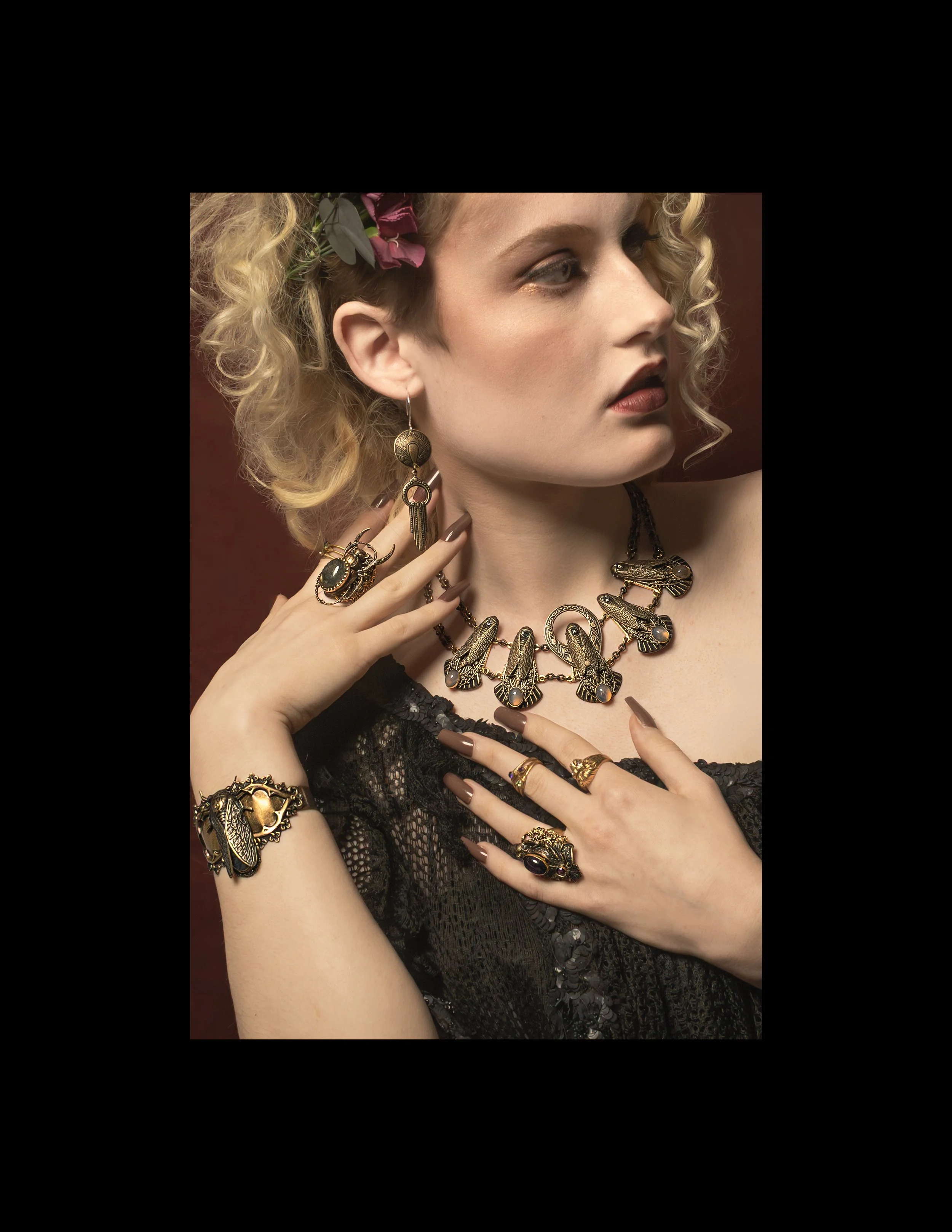
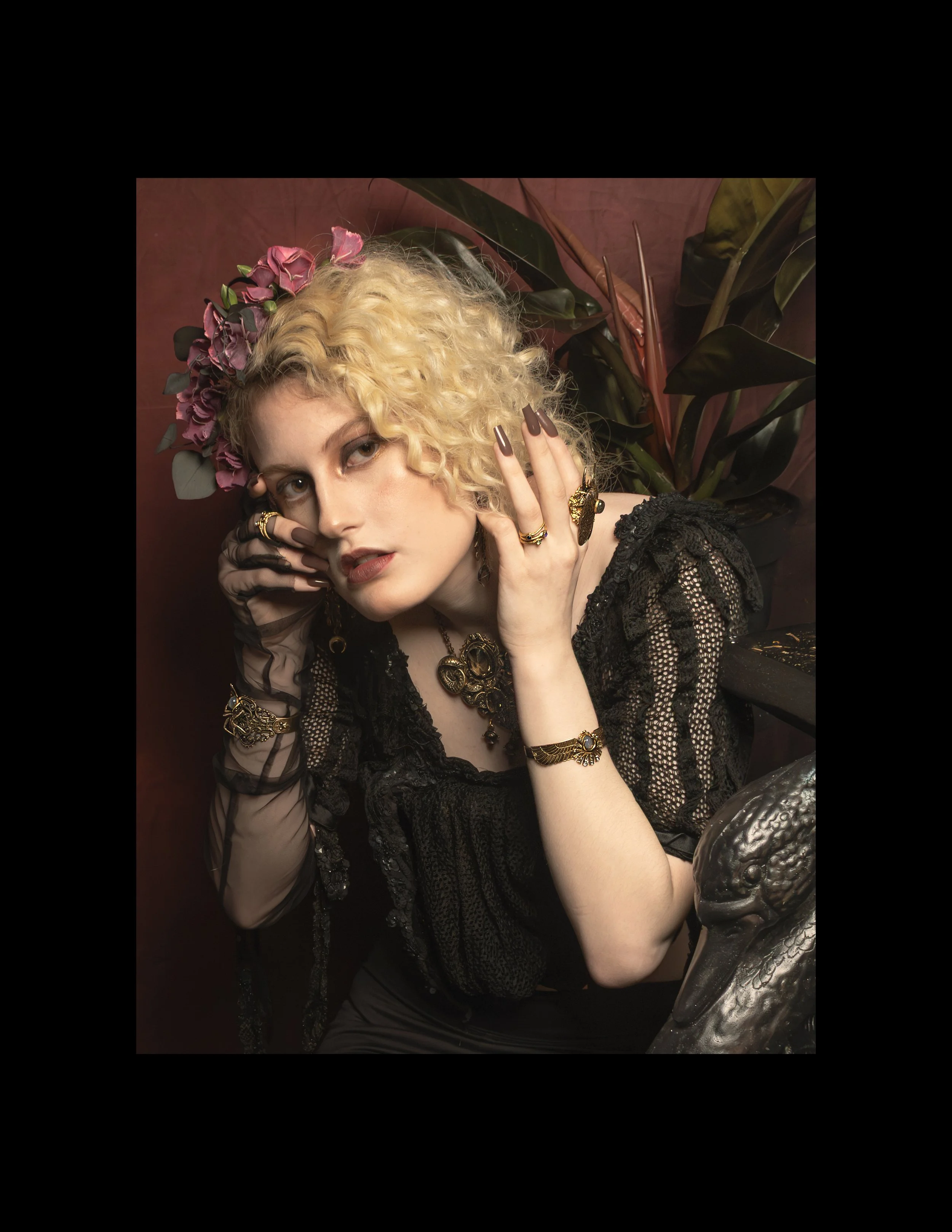
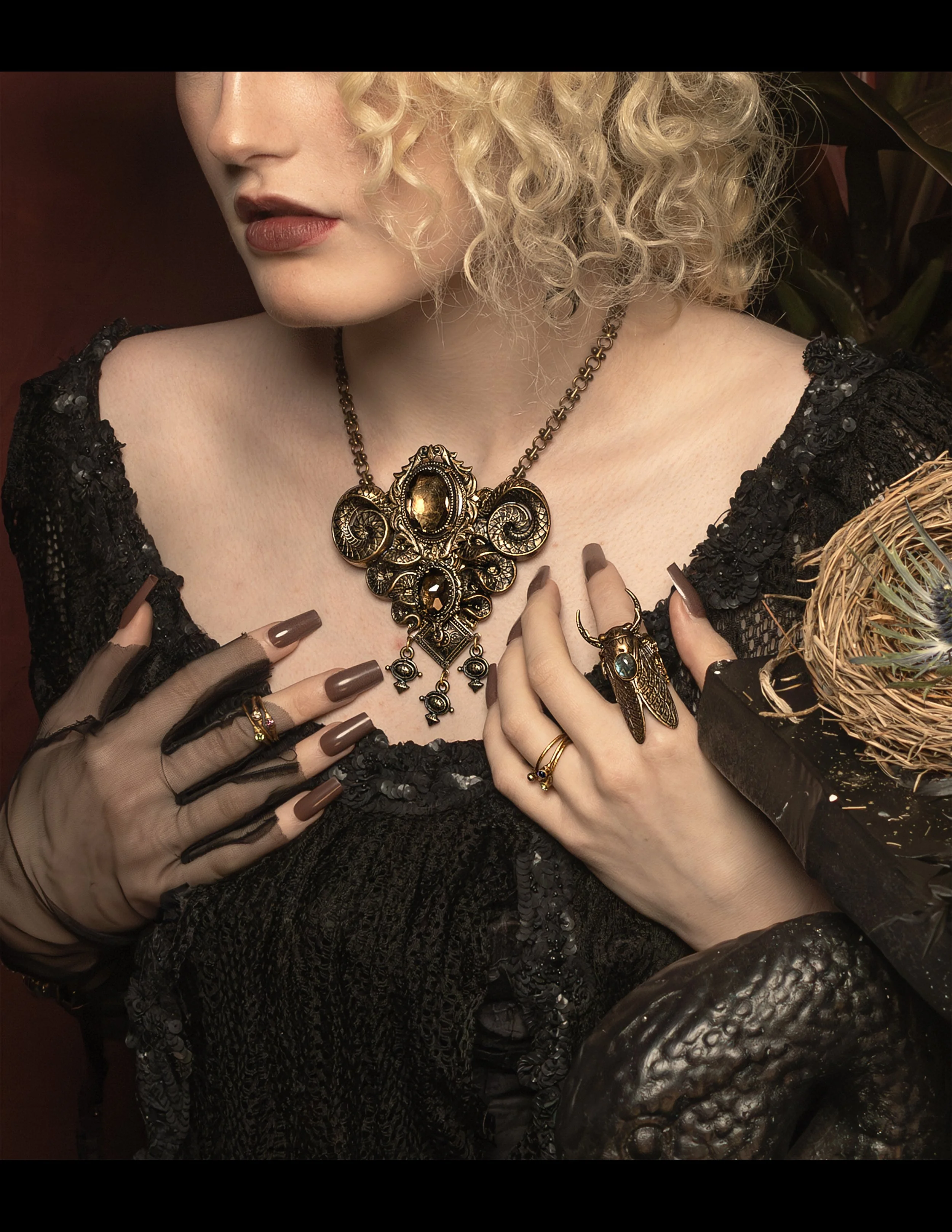
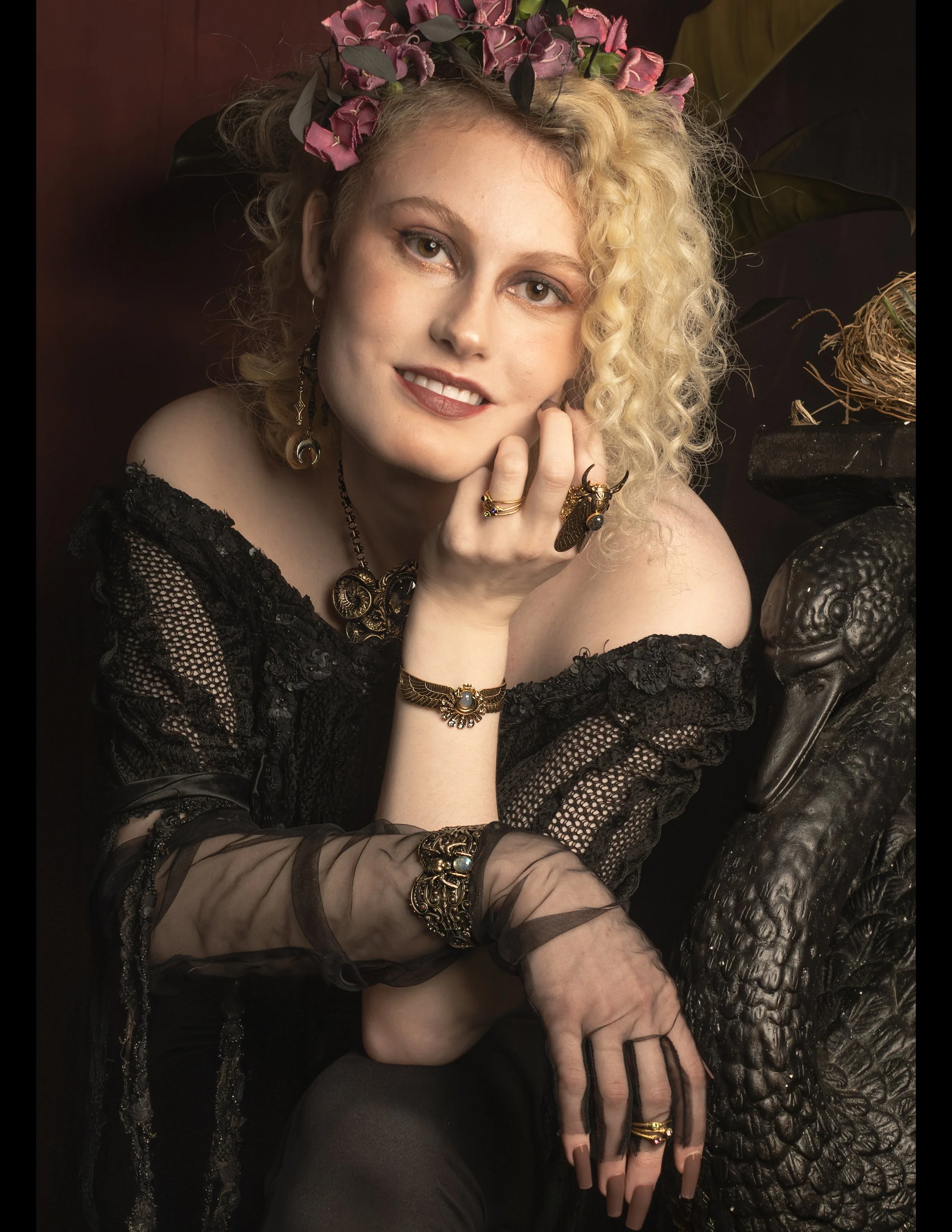
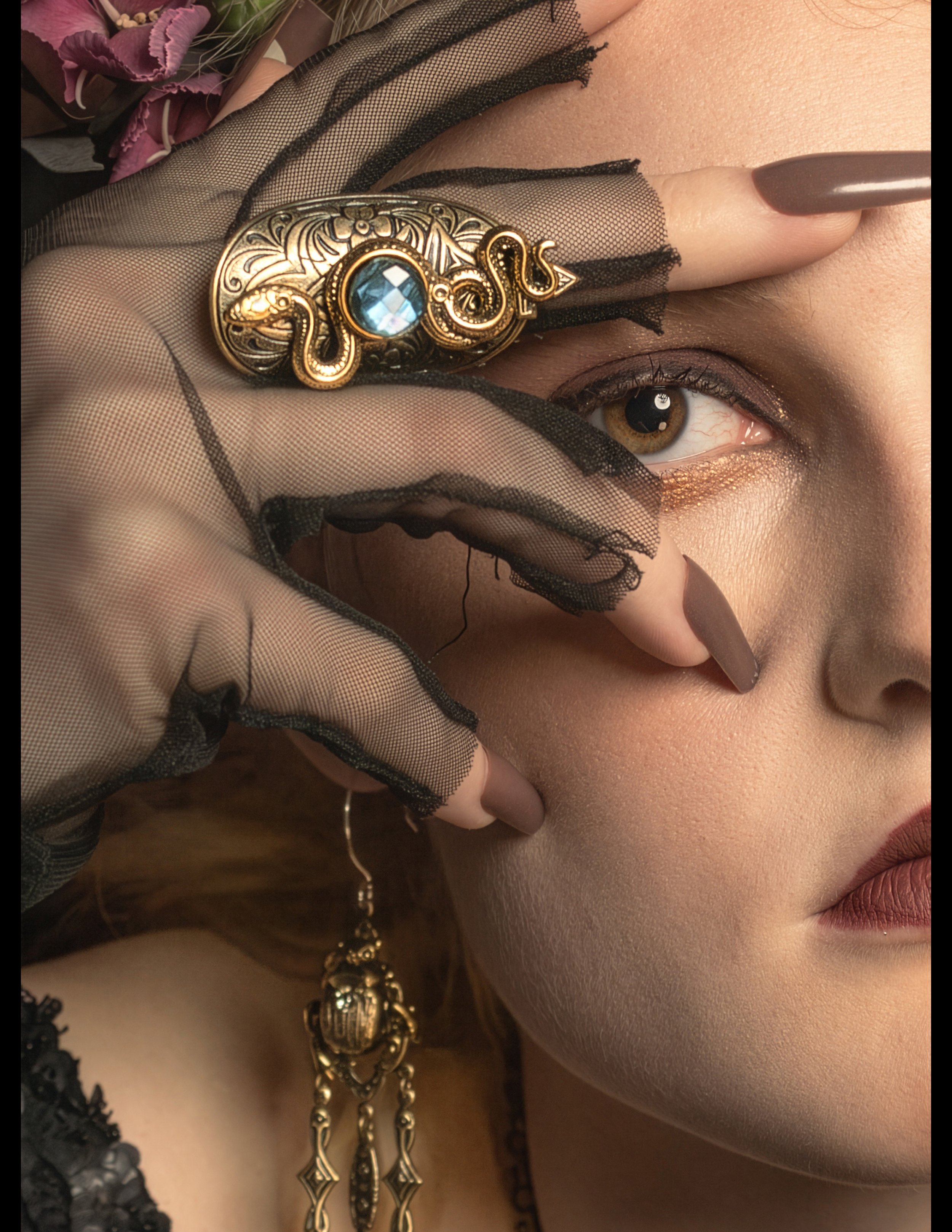
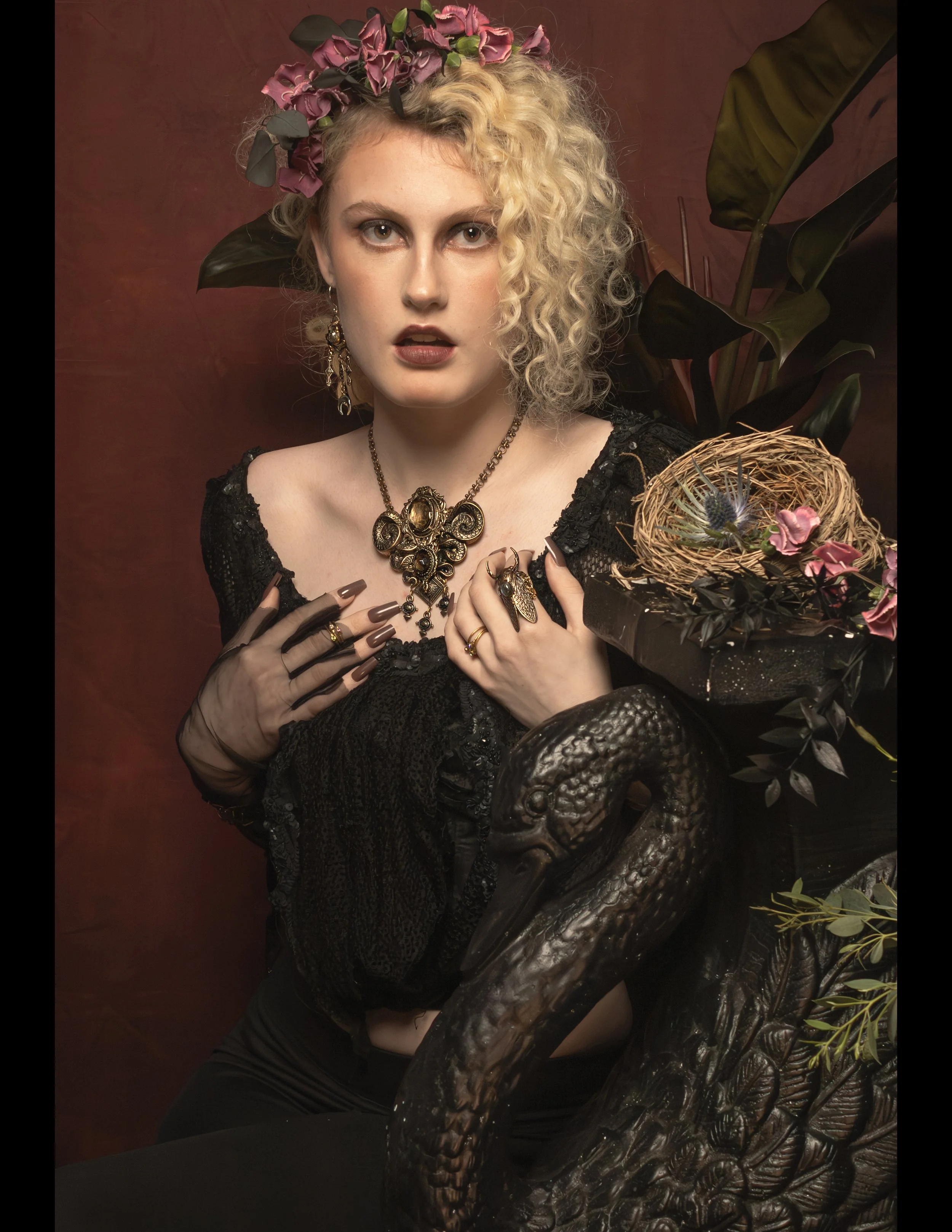
This particular editorial came together in a lovely way. Magic is very much aligned with Trollbinde’s design concepts, so perhaps all those beautiful talismans worked their own “magick” in bringing our collaboration together.
A couple of years ago, my longtime friend Skirt Vonnegut, a drag king and circus performer based in Chicago, introduced me to a jewelry booth in Asheville, North Carolina, where we were both living at the time.
I saw Hannah Wood’s designs and was immediately bewitched, so to speak. I was fascinated by the way she combined metals, gemstones, reptiles, and insects to create such reverent pieces of wearable art.
I contacted Trollbinde through the company’s website and asked whether Hannah might be interested in collaborating. I was absolutely thrilled when she said yes. She found our model, Sadie, and I invited makeup artist Kate to join the project. Together, we tried to bring all of that magic to life through a creative editorial centred on Trollbinde’s designs.
I only recently decided to release many of these images because I moved to New York City last year, where I have focused almost entirely on fashion and beauty photography.
In this particular case, I was deeply inspired by the product. However, I am equally inspired by the talented people I work with, and I am always grateful for the contributions of a strong creative team.
5. What do you want people to feel when they look at your images?
Feelings are subjective and highly individual. People are free to feel whatever they feel when looking at my work, and I neither can nor wish to control that.
What I want them to see, however, is a visual feast: colors, textures, and boldness. I often joke that I do not have much patience for subtlety. I like it when an image reaches out and slaps the viewer.
6. How do you build trust and connection with the model during a shoot?
During the first part of a shoot, I give very specific posing directions—even down to details such as chin placement and where the model should direct their eyes. Sometimes, I use tape to mark the area in which the model should pose.
I find that, after a certain amount of time, most people begin to relax naturally into their role and pose more freely. At that point, I adapt to their natural cadence. I begin listening to their movements and expressions rather than asking them to continuously listen to my directions.
That transition creates a more intuitive and collaborative rhythm between us.
7. What has been one of your most memorable photoshoots so far, and why?
My most memorable and rewarding shoots have been those in which the person in front of my camera felt genuinely seen.
Working with transgender and non-binary people has been particularly meaningful to me. When someone who has faced adversity simply for living authentically tells me that our shoot made them feel appreciated, beautiful, and fully recognized, that experience stays with me.
Photography can offer more than a finished image. It can give someone a moment of liberation and a chance to see themselves without the limitations, judgments, or expectations imposed on them by others. Those are the shoots I remember most because they reaffirm why I create.
8. How important is storytelling in your work?
I do try to tell stories, but people inevitably bring their own stories to what they see in an image.
Perhaps storytelling is not only about what the photographer and creative team set out to communicate. It may also be about whether the viewer is reminded of something beautiful, poignant, or even painful from their own life.
In that sense, perhaps editorial photographers are really telling other people’s stories—albeit indirectly.
9. What challenges do photographers face today in the creative industry?
People speak frequently about the new challenges photographers face today, and many of those concerns are entirely valid. For example, businesses are increasingly using artificial intelligence to create content rather than hiring creative teams for branding work.
However, a machine cannot truly see or understand the human element. Technology may be able to imitate certain visual styles, but it cannot replace the lived experiences, relationships, emotions, and genuine connections that shape meaningful creative work.
To survive in almost any creative industry today, we must return to the familiar themes of boldness and fearlessness. We have to keep moving headlong into the future. When we stop and dwell endlessly on our fears, we begin losing ground. When photographers believe they cannot compete with AI, they risk surrendering before the real creative work has even begun.
10. What advice would you give to new photographers who want to develop a strong artistic identity?
Be loud. Be bold. Photograph as much as you possibly can, and continue doing so regardless of what may or may not happen in some unknowable future.
Every profession and art form is being affected by technological development. Self-checkout systems and autonomous vehicles are doing to retail and taxi services what photographers fear AI may do to commercial and branding photography.
Whatever the future holds, we are all entering it together. We must adapt without surrendering the humanity, individuality, and creative courage that give our work meaning.
As the old saying goes, “The only constant is change.” Do not allow that change to silence you. Use it as a reason to become even more fearless in discovering and expressing who you are.
CONCLUSION
Audrey Hope Rinehart’s journey is a compelling reminder that photography can be both an artistic practice and an act of liberation. From her beginnings as a model searching for greater creative agency to her emergence as a fearless image-maker, she has transformed her experiences into a visual language that celebrates boldness, individuality, and human connection.
Her photographs refuse to whisper. They invite viewers into worlds rich with color, texture, identity, and unapologetic self-expression. Yet beneath their striking beauty lies something even more powerful: a sincere commitment to helping others feel seen.
In an industry continuously reshaped by technology and changing conventions, Audrey’s philosophy remains clear—move forward boldly, reject shame, and never allow fear to define the limits of your creativity. Through her work, she does not merely photograph people; she gives them room to spread their wings.