

Elle Farrell-Kingsley’s
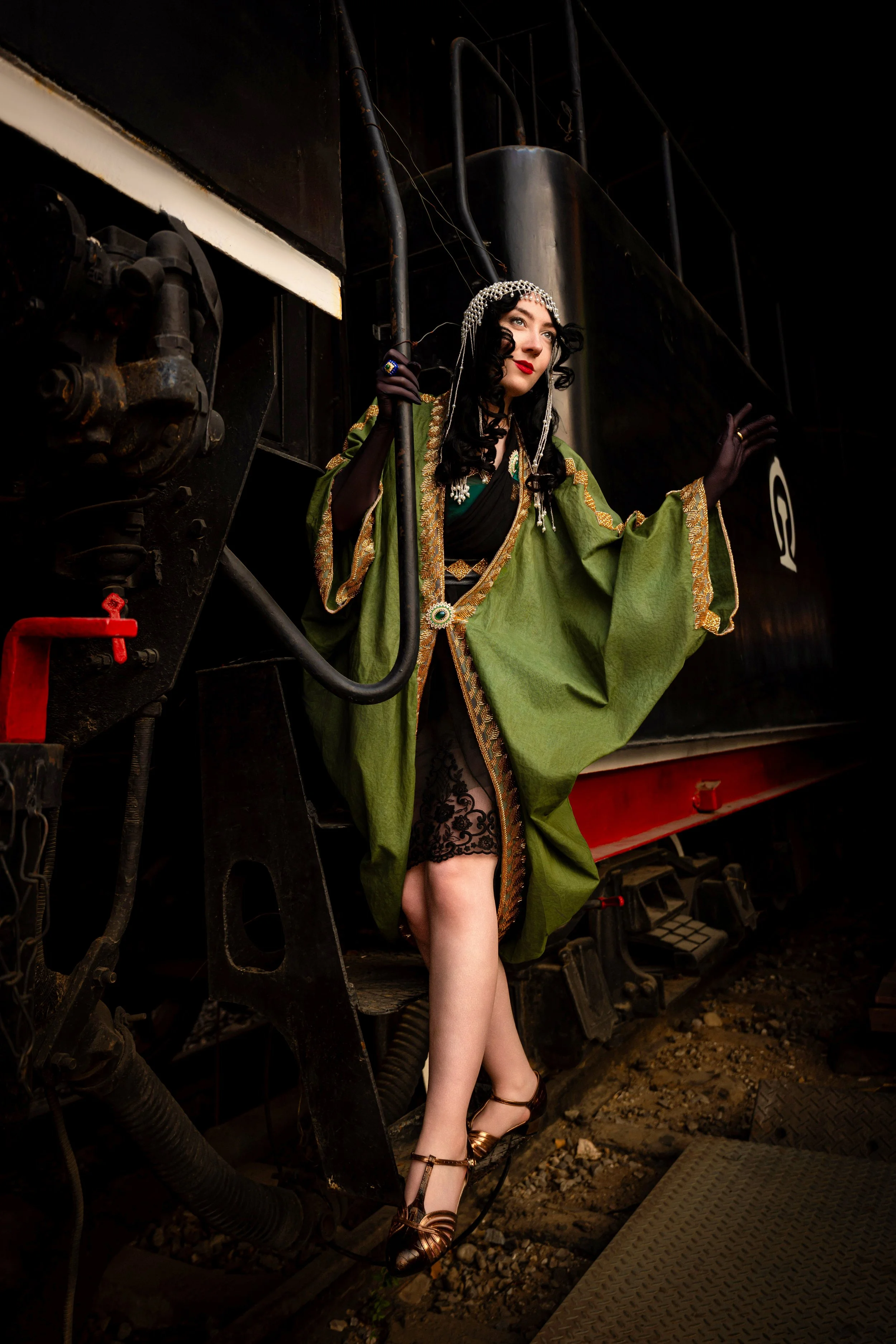
Elle Farrell-Kingsley’s work exists in that rare space where fashion becomes cinema, memory, and character all at once. In this interview, she reveals the layered process behind a striking editorial inspired by 1920s silhouettes, silent film presence, Art Deco atmosphere, and the romance of early train travel. As both designer and model, Elle does not simply wear the garment — she inhabits the world she has created. Through hand-beading, historical references, theatrical proportion, and a deeply cinematic eye, she transforms fashion into a scene from an imagined film, suspended somewhere between archive, fantasy, and dream.
Can you tell us about the original concept behind this shoot and what inspired you to create it?
Well, I was invited to a 1920s Murder on the Beijing Express mystery party, and the dress code sparked the initial idea. From there, I began curating visual and cultural artefacts rather than constructing a fixed narrative. I assembled snippets, such as silent film stills of 1920s actress Evelyn Brent, Paul Poiret’s cocoon silhouettes, and imagery tied to early steam travel.
I also spent time working through archival material and vintage fashion posters. This research stage is one I tend to stay with for a while. It gradually forms its own internal world before design decisions are made.
As both the model and the fashion designer for this editorial, how did you approach building a character and visual world through your design?
Because I was both creating and embodying the piece, I approached it almost like costume design for a film that didn’t yet exist. I built the world first, imagining a 1920s train in motion, travelling between places without a fixed destination. Then, I considered who might exist within that setting.
The character became someone suspended, not fully anchored to date or place. Like Brent’s on-screen presence, she isn’t meant to represent an everyday woman. Every design choice, from silhouette to beadwork, was made with that in mind, so stepping in front of the camera felt less like modelling and more like stepping into a role already constructed through the garment.
You mentioned inspiration from Paul Poiret’s 1920s cocoon coats mixed with the aura of silent film star Evelyn Brent — what drew you to those references, and how did you reinterpret them in your own way?
What drew me to Poiret was the shift away from restriction. The cocoon coat is structurally simple but conceptually radical, it replaced the Victorian corseted form with volume and movement. Brent inspired something different: control. Her stillness on camera feels deliberate and contained, which aligned with the restrained tone I was aiming for.
I wasn’t trying to recreate the 1920s literally, but more to translate its principles. The proportion is exaggerated, the detailing more theatrical, and I introduced my own language through the draping, lace and beadwork. Those elements aren’t really traceable to a single source, but I’d say they’re where the piece moves from history into interpretation.
What was the design process like for this garment, from the first idea to the final finished piece seen in the images?
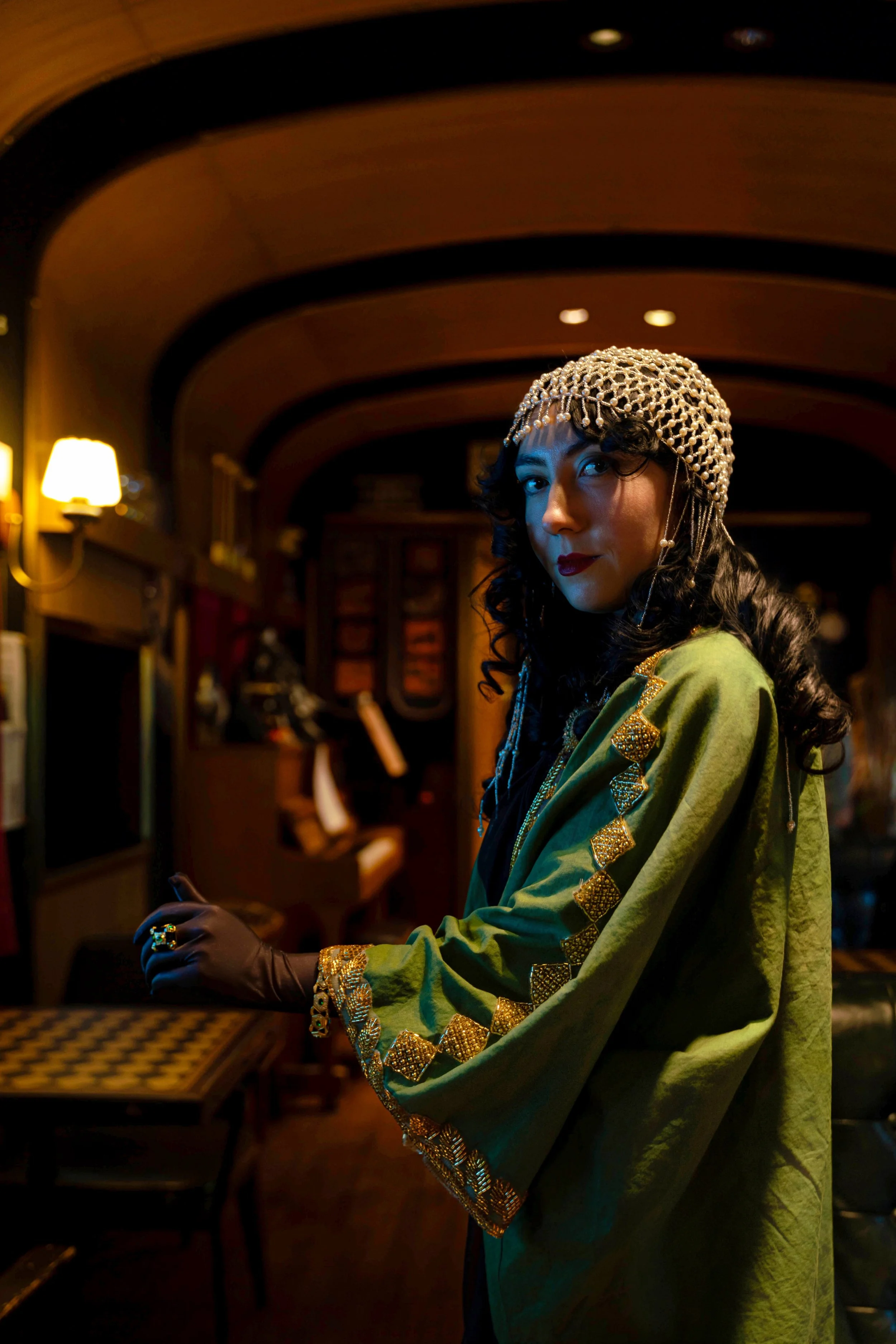
It began with a vintage sewing pattern, which I used as the foundation. I widened the sleeves in response to late 1920s silent film silhouettes. And it was pretty daunting to take it in my own direction. The resulting shape took more of an open, draped sleeve structure, enhancing the theatrical stillness. From there, the coat and dress developed intuitively, based on draping, rather than following a fixed plan.
I was also thinking about the broader visual language of the 1920s — how Art Deco engaged with East Asian visual culture through stylised ornament and patterning, while in Shanghai, the qipao was being modernised into an iconic, fitted silhouette within its own evolving fashion context. Set within the fictional premise of Murder on the Beijing Express and photographed in Beijing, these references shaped the atmosphere.
Then, green and gold were selected for their association with Art Deco opulence and period glamour. The hand-beading stage is slow and immersive, so I often listen to history or philosophy lectures while working. After styling and hair, the piece fully came to life.
What details, shapes, fabrics, or embellishments were most important to you in capturing that vintage yet theatrical mood?
I often begin with the silhouette. For this, I returned to the cocoon form, volume replacing structure.
Material choice is equally important for me. I avoided mass-produced plastic sequins in favour of glass beads, which are closer to the materials used in this period and reflect light in a more uneven, lived way. For the coat, I used linen, while the dress features tulle, as is more common in older pieces. Tulle, however, is quite sheer, so ensuring it wasn’t see-through became an important construction challenge. This was resolved by layering multiple sections and adding lace, which provided the necessary opacity while enriching the texture.
Accessories also helped it come together. The headpiece draws upon Juliette caps, which were fashionable, while the heels nod to that old sense of glamour associated with train travel.
How did you balance historical inspiration with your own creative identity so that the design felt referential while still remaining original?
It was about letting all of these different influences come together to create something new. Some references remain in the research stage but still shape proportion and mood. Others are more visible in the final garment.
The beading and lace introduce my own language, so the piece feels like it could belong to that time, but isn’t trapped inside. It sits somewhere between archival reference and imagined memory, something that feels familiar, but can’t be placed exactly.
Did stepping in front of the camera while also knowing every detail of the design change the way you performed or embodied the look?
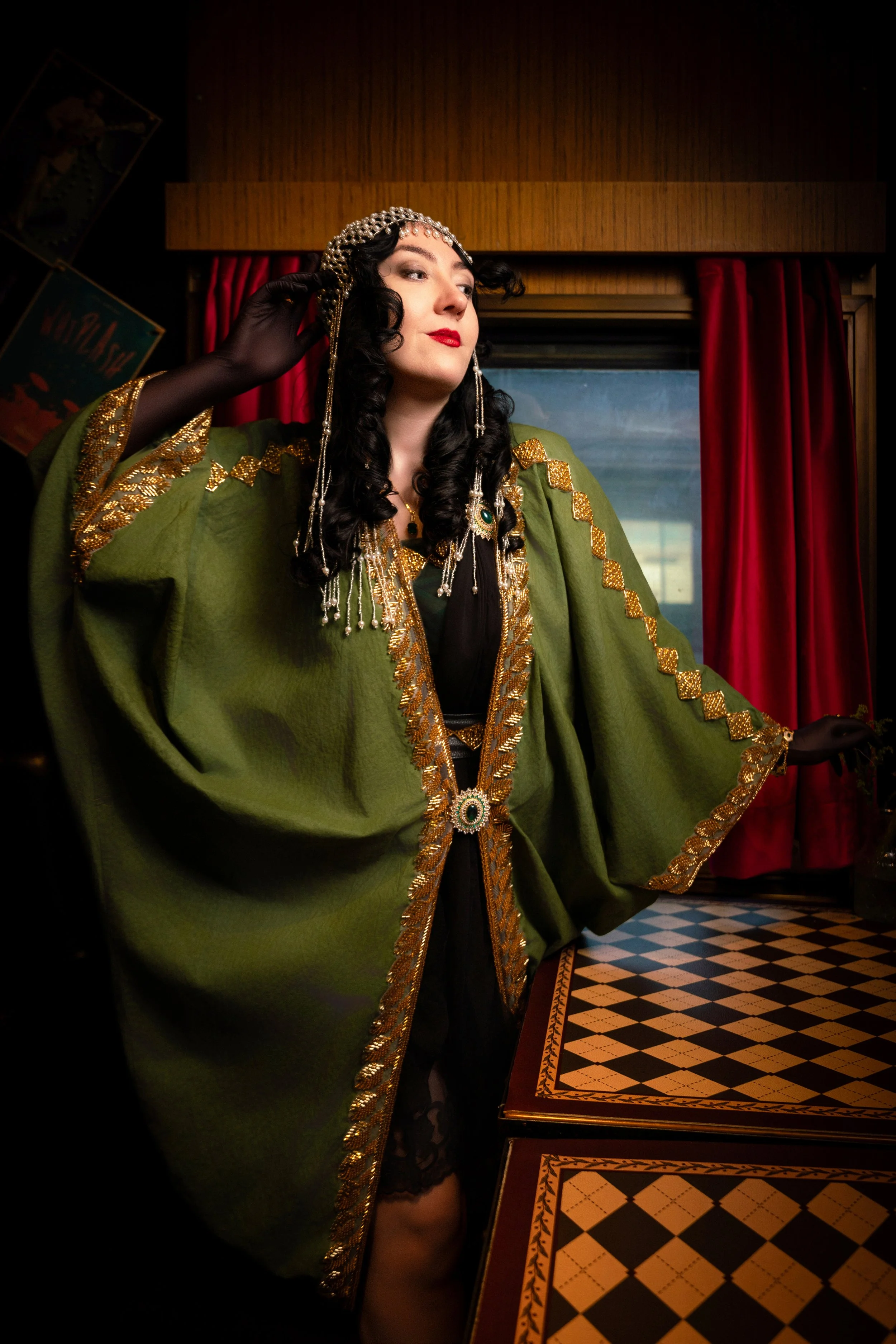
Yes, completely. Once you know exactly how a garment holds and releases shape, you stop posing in a traditional way and start reacting to it. In this case, the widened sleeves and softer structure meant movement was key. I tried to respond to the fabric's behaviour, as though it were a living extension of the character. Small shifts, such as how a sleeve falls back or how the coat opens, guided the gestures.
The shoot has a strong cinematic atmosphere, almost like a forgotten silent-era fantasy. How did you work as creative director to shape that mood visually?
I approached it like directing a scene from a lost silent film, something half-remembered and slightly out of reach. The train setting is visually dominant, so the challenge was balancing restraint with theatricality. I also considered lighting and texture, the aged exterior of the train against the richness of the materials. Together, they suggest a time without keeping it fixed, keeping the scene in motion.
I must also credit the photographer on this shoot, Mikhail, whose artistic eye was essential in creating what you see.
What do you hope viewers notice first when they see this design, and what feeling or story do you hope it leaves behind?
The first impression should be the silhouette, which was always the priority. Ideally, it should read immediately, even from a distance. Beyond that, I was hoping for a sense of narrative ambiguity, like something is happening just outside the frame — unresolved and still unfolding.
Looking back on this project, what did this experience teach you about your voice as a designer and creative director, and where would you like to take that vision next?
This project helped reveal my style as rooted in cinematic storytelling and couture world-building. Looking forward, I’m interested in expanding this into more spatial contexts. The project I’m developing, The Vintage Futurist, builds upon historical patterns but places them within experimental materials and environments, where garments exist as part of a larger, constructed story rather than as a single image.
Elle’s work carries the elegance of history, but never feels trapped by it. Every sleeve, bead, fabric choice, and gesture becomes part of a larger story — one that feels timeless, mysterious, and carefully constructed. Her vision is personal, atmospheric, and unmistakably her own. With projects such as The Vintage Futurist ahead, Elle Farrell-Kingsley’s creative voice feels ready to expand even further, moving beyond the garment and into full worlds of cinematic design, emotion, and imagination.
Model & MUA & Fashion & Cr Dir & Hair & Photo: @ellefkingsley
Photo: @fotomikhanix